My Flounder Gigging Boat: A J16 Built Around Light and Battery
Flounder gigging is a night game, which means the whole boat gets built around two things: light and the battery to run it. Here’s the actual setup on my Carolina Skiff J16, piece by piece, including the real numbers off the battery after a full night on the water.
The boat: why a J16
A Carolina Skiff J16 is about as simple a hull as you can buy — flat-bottomed, shallow-draft, and stable enough to stand on off-center without feeling it, which is exactly what gigging demands. I built a custom front deck onto mine specifically to gig from: a raised, flat platform up on the bow that puts you above the water looking down into it instead of leaning over a low rail, with the above-water lights mounted flush to the deck itself and poles rising off the perimeter carrying the underwater lights down into the water.
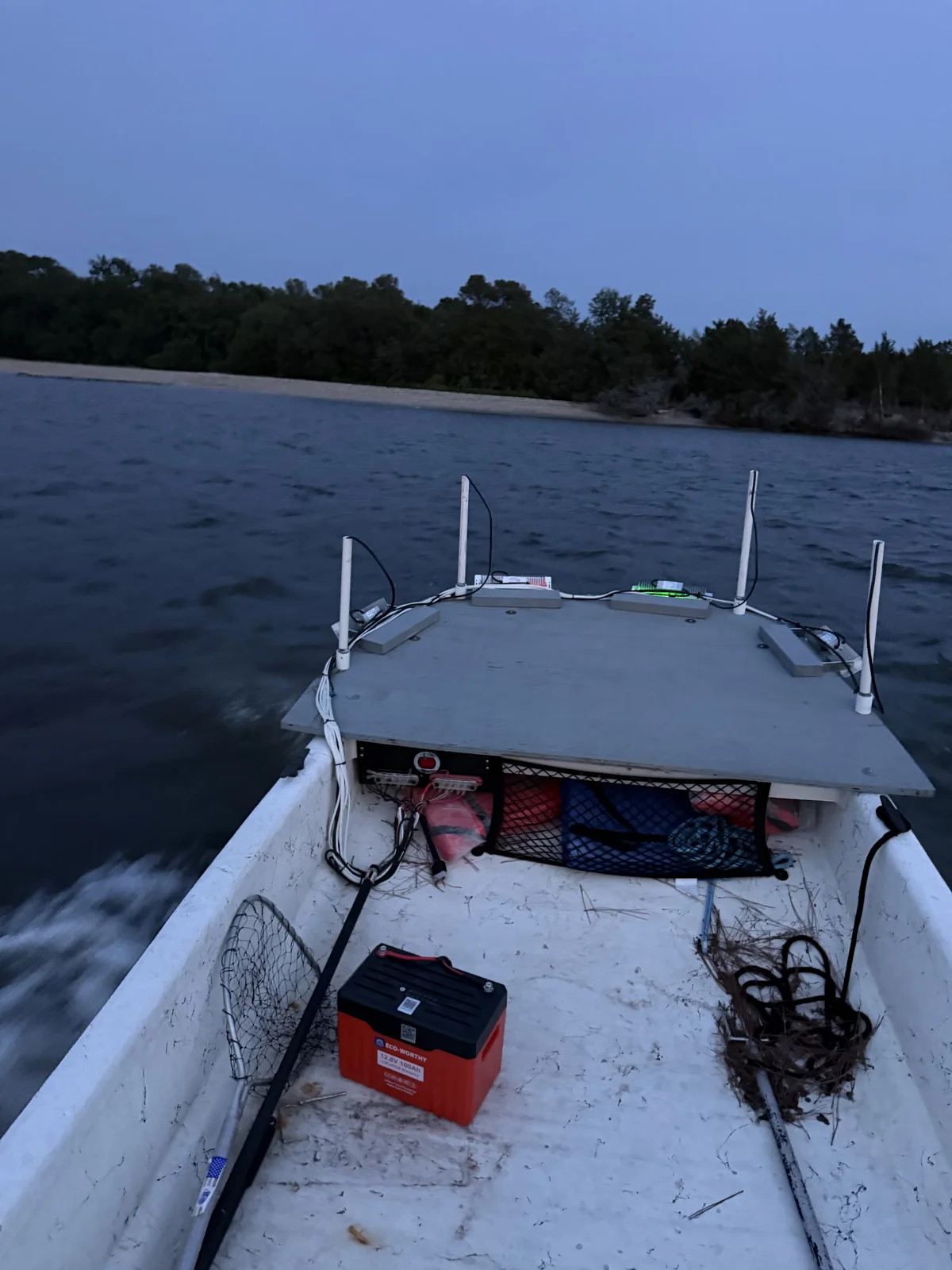
That poling-platform-style deck is really the whole build — everything else on this page exists to put light in the water off of it.
The lighting: above and below the surface
Above water: four 5 Star LED S50 lights, run in the 12V DC version, mounted flush to the front deck itself rather than up on poles. Each one is a 50-watt, 6,000-lumen fixture pulling about 4.1 amps at 12V, IP67-rated so salt spray and rain aren’t a concern, with a 90-degree beam angle that throws a wide, even patch of light rather than a narrow hot spot. Four of them mounted around the deck covers the water around the boat with no dark gaps for a flounder to sit in unseen.
Below water: Jerry’s LEDs handle the underwater side of the rig, mounted on poles rising off the deck so the lights hang down into the water itself rather than sitting at the surface. That gets them past the surface glare the S50s create and puts light directly down onto the bottom. Running both layers together — deck-mounted lights covering the water around the boat, pole-mounted lights lighting up the bottom directly beneath and around them — is what actually lets you spot a flounder lying flat on the bottom instead of squinting through reflection.
Wiring: buss bar in, Anderson connector out
All four S50s and the underwater lights land on a single buss bar — positive terminals on one side, negative on the other — so the whole lighting rig is one harness instead of four or five separate runs fighting for space at the battery. From the buss bar, everything runs through an off switch and out to an 8AWG Anderson-style quick-connect cable, a 50-amp-rated connector that lets me unplug the entire lighting harness from the battery in one motion instead of unbolting individual terminals. It’s a small thing, but being able to disconnect the whole rig with one plug — for storage, for swapping batteries, or just to kill everything fast — is worth the $20 on its own.
Power: a 300Ah lithium bank, and the real runtime
The battery is a ECO-WORTHY 12V 300Ah LiFePO4 lithium battery — Bluetooth app monitoring, a built-in 200A BMS, and at 4.6 stars over more than a hundred ratings it’s a well-proven battery in the RV and solar crowd, not just a marine niche product. (Note: this exact listing has since been bumped from 300Ah to 314Ah by the manufacturer — same battery family, slightly more capacity if you buy today.)
Here’s the number that actually matters: after four hours of running the full lighting rig on a real night out, the battery had only dropped to 75% state of charge. That’s 75Ah used in 4 hours, which works out to roughly 18.75 amps average draw for the whole system — lights, wiring losses, everything. That number lines up well with the math on paper: four S50s at 4.1A each is 16.4A on the above-water lights alone, so the underwater lights and any wiring loss account for the rest. At that draw, a full 300Ah charge has something like 16 hours of lighting in it on paper, and realistically 12-plus hours if you don’t run it all the way to empty — which is more light than one night of gigging needs by a wide margin, with real reserve left for a second trip before recharging.
Know the rule that makes this whole rig legal
South Carolina flounder limits are a 16-inch total length minimum, 5 fish per person per day, and no more than 10 fish per boat per day — and that bag limit applies whether you’re fishing hook and line or gigging. The rule specific to gigging, and the reason this entire lighting setup exists in the first place: it’s unlawful to gig for flounder in South Carolina salt waters during daylight hours. Gigging is a night-only method here, full stop, which is exactly why a rig like this one — real light above the water, real light below it, and a battery that outlasts the trip — is the whole game. Regulations change, so check current size, bag, and season rules with SCDNR before you go.
Bottom line
A flat, stable hull with a purpose-built deck, overlapping above-water and underwater light, a single buss bar to keep the wiring sane, an Anderson connector to make it all disconnect in one motion, and a lithium battery with real reserve to spare — that’s the whole formula. None of it is complicated; it just has to all work together, in the dark, without anything going wrong at the worst possible moment. The latest addition wasn’t electrical at all — see the cable-to-hydraulic steering conversion for why the boat needed it.
This article may contain affiliate links. If you buy through them, we may earn a small commission at no extra cost to you. Learn more.