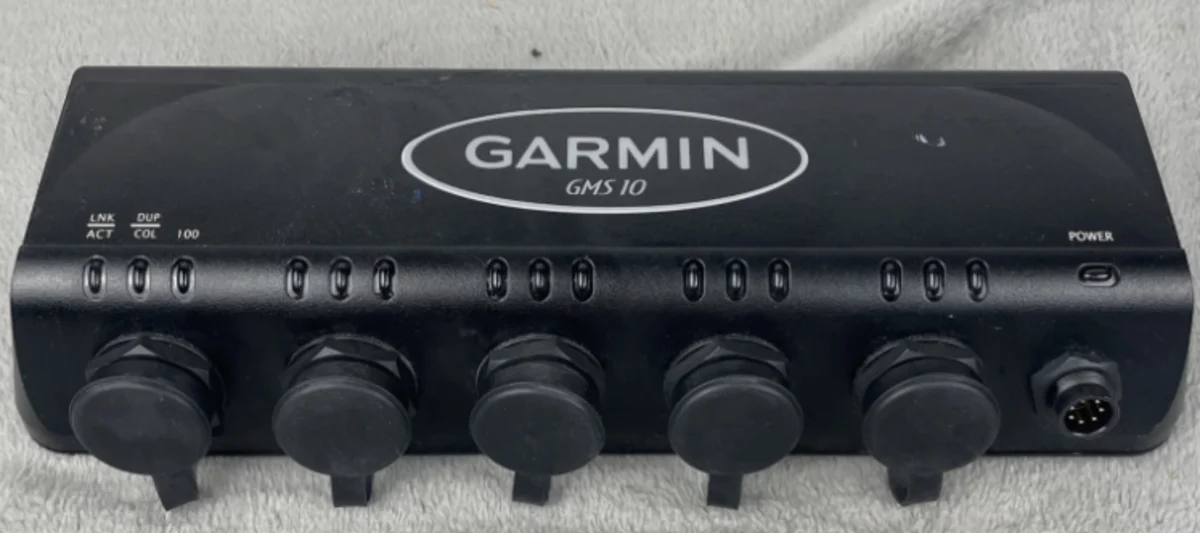
NMEA 2000 Setup Guide: Backbone, Drops, Termination, and Power
NMEA 2000 is the network doing the most work on a modern boat — GPS, depth, wind, engine data, autopilot commands, and AIS all typically ride on it, and it’s the reason a new instrument usually just works the moment it’s plugged in rather than needing its own dedicated wiring back to every other device. It’s also a CAN-bus system (the same underlying technology as automotive networks, via the SAE J1939 standard it’s derived from), which means it has real rules about topology and termination that aren’t obvious if you’ve only worked with point-to-point wiring like NMEA 0183. This guide covers those rules. For where NMEA 2000 fits next to NMEA 0183 and marine Ethernet, see the networking overview.
Backbone and drop: the topology that matters
NMEA 2000 runs on a backbone — a single continuous cable run that forms the spine of the network — with individual devices connecting to it via short drop cables through T-connectors, rather than daisy-chaining device to device. Every device gets its own drop off the backbone; you don’t plug one instrument into another instrument’s spare port. This is the single biggest conceptual difference from NMEA 0183, and it’s what lets you add or remove a device without disturbing anything else on the network.
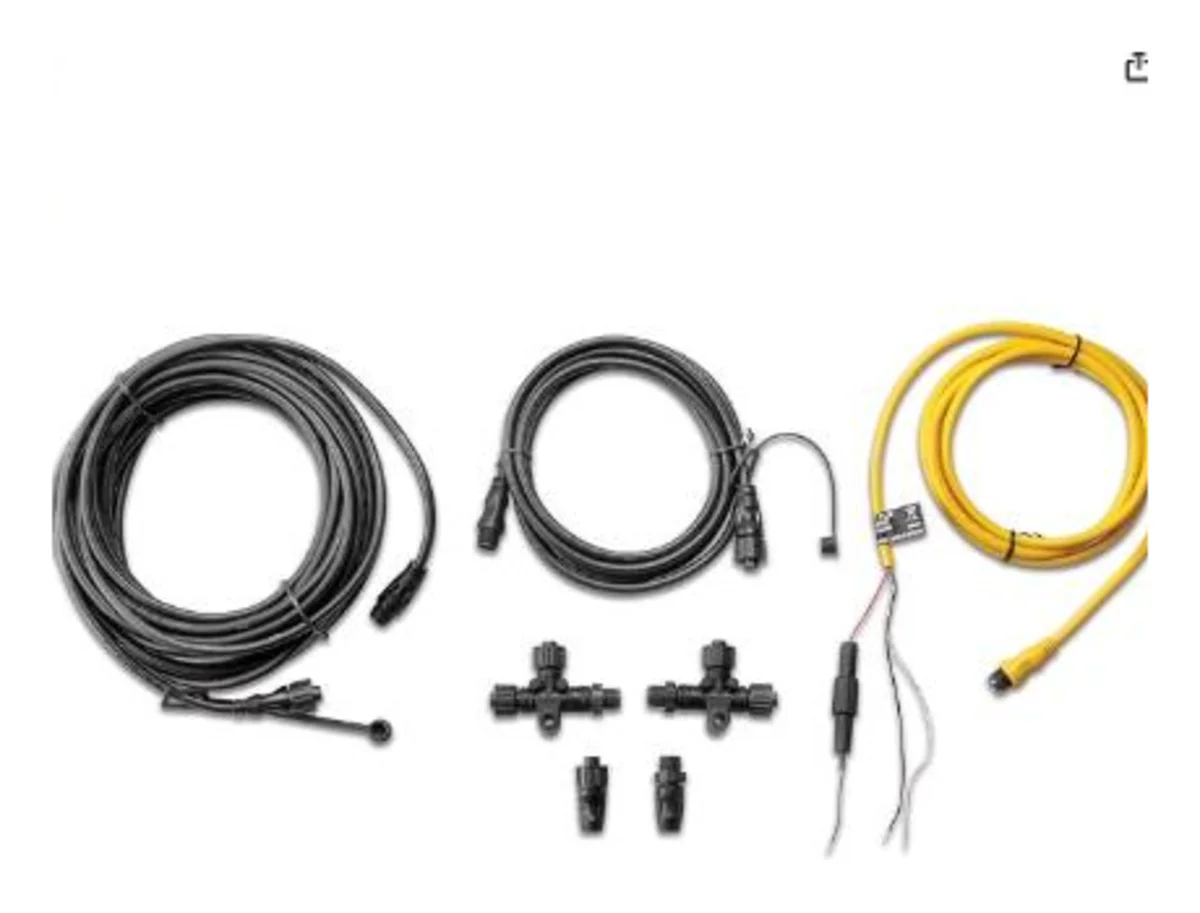
The Garmin NMEA 2000 Starter Kit pictured above is a genuinely useful reference for what a basic setup contains: a length of backbone cable, T-connectors to tap into it, short drop cables to reach individual devices, and a power cable with an in-line fuse to feed the whole bus.
The rule that trips people up: termination resistors
Every NMEA 2000 backbone needs a 120-ohm termination resistor at each end — two total, not one, and not more. Terminators absorb the electrical signal at the ends of the bus and prevent reflections that corrupt data; skip them, use only one, or add extras in the middle of the run, and you’ll get intermittent, hard-to-diagnose communication errors rather than a clean failure that’s obvious to troubleshoot. If a NMEA 2000 network is acting flaky — devices dropping in and out, inconsistent readings — checking for exactly two terminators, one at each physical end of the backbone, is one of the first things to verify.
Size limits: backbone, drops, and node count
A NMEA 2000 backbone has real length limits: maximum 100 meters of total backbone cable, and each individual drop cable maxes out at 6 meters — though Garmin’s own spec allows up to 78 meters of combined drop cable length across the whole network, which matters more than the single-drop limit on a boat with a lot of devices spread out. The network also supports a maximum of 50 physical nodes (devices) on one bus. Most recreational boats never get close to either limit, but it’s worth knowing before assuming you can run backbone the length of a large boat with zero planning.
Power budget: LEN and why a big network sometimes needs a second power tap
NMEA 2000 devices draw power directly off the backbone, measured in LEN (Load Equivalency Number), where 1 LEN equals 50mA at 9-16V nominal. Every device you add subtracts from the power budget available at that single power connection point. In practice, a single power tap can reliably support somewhere around 3 amps — roughly 60 LEN worth of devices — before voltage drop across the network starts causing problems, especially at the far end of a longer backbone. A boat with a chartplotter, GPS, depth, wind, engine gateway, and autopilot might be fine on one power tap; a boat adding radar interfaces, multiple displays, and several sensors on top of that should plan for a second power insertion point elsewhere on the backbone rather than overloading the first one.
Connector types: Mini vs. Micro
NMEA 2000 hardware comes in two connector/cable sizes. Mini connectors and cable are rated for roughly 8 amps and are the right choice for backbone runs and any point carrying significant power, especially on larger networks. Micro connectors and cable are rated for about 3 to 4 amps — fine for drop cables to individual low-draw sensors, but not for backbone runs on a network with more than a handful of devices. Mixing the two is normal (Mini backbone, Micro drops to sensors); using Micro for a backbone that needs to carry real current is the mistake to avoid.
PGNs: how devices know what they’re looking at
Every piece of data on a NMEA 2000 bus is tagged with a PGN (Parameter Group Number) that identifies what kind of message it is — depth, GPS position, engine RPM, wind speed, and so on. Any device on the bus can listen for the specific PGNs it cares about and ignore the rest, which is what lets a chartplotter, an autopilot, and a standalone depth display all read from the same physical bus without interfering with each other. You don’t need to work with PGNs directly for a normal install, but it’s useful to know the term if a device’s spec sheet lists which PGNs it supports or requires — that’s the actual compatibility check between two NMEA 2000 devices from different brands.
Dos and don’ts
Do terminate both ends of the backbone with 120-ohm resistors — no more, no fewer.
Do use Mini-rated cable and connectors for the backbone itself, especially on any network with more than a few devices.
Do plan a second power insertion point before a growing network exceeds roughly 60 LEN / 3 amps at the existing tap.
Don’t daisy-chain devices directly to each other — every device gets its own drop off the backbone through a T-connector.
Don’t exceed 6 meters on a single drop cable or mix brands’ proprietary connectors (like Simrad’s SimNet) directly onto standard NMEA 2000 cable without the correct adapter.
Don’t ignore intermittent data glitches as “just how it is” — on a CAN-bus network, that’s almost always a termination or power-budget problem with a specific, fixable cause.
What data typically runs on NMEA 2000
GPS position and speed, depth, water temperature, wind speed and direction, engine RPM/temperature/fuel data, autopilot heading and rudder angle commands, modern AIS targets, and increasingly, integration with electric and hybrid propulsion systems. This is the layer that makes a Force Kraken trolling motor talk to a chartplotter for spot-lock, and what feeds a MSC 10 satellite compass into a full autopilot system.
Bottom line
NMEA 2000 is genuinely simple to expand once the backbone is built correctly the first time — the entire practical challenge is getting topology, termination, and power right at the start. Two terminators, proper drop cables off a Mini-rated backbone, and a power budget that accounts for everything on the bus covers the vast majority of what goes wrong on a real boat.
This article may contain affiliate links. If you buy through them, we may earn a small commission at no extra cost to you. Learn more.