EPIRB vs. PLB: What Offshore Boats Actually Need
The offshore safety checklist calls the EPIRB/PLB “the single most important thing on the list that a lot of boats still don’t carry,” and that’s still true. This is the deeper dive on that one item — what an EPIRB actually is versus a PLB, how the rescue system behind either one works, what it costs to own long-term, and exactly what belongs in the ditch bag they live in.
EPIRB vs. PLB: the real difference
An EPIRB (Emergency Position-Indicating Radio Beacon) registers to the boat. It’s larger, mounts in a bracket, and on the better versions activates itself — no one has to do anything for it to start transmitting. A PLB (Personal Locator Beacon) registers to a person instead of a vessel, is small enough to clip to a PFD or pocket, and has to be manually switched on. Both broadcast on the same 406 MHz distress frequency plus a 121.5 MHz homing signal that search aircraft can direction-find once they’re close.
Neither is federally required on most U.S. recreational boats — the Coast Guard mandates EPIRBs mainly for commercial and SOLAS vessels. That’s exactly why so many boats running the canyons don’t have one: nothing forces the purchase, right up until it’s the only thing that would have mattered.
Category I vs. Category II: the activation question
This is the detail that actually matters for a boat that runs short-handed. Category I EPIRBs mount in a hydrostatic release bracket and deploy themselves — if the boat sinks, water pressure at 1.5 to 3 meters trips the release, the unit floats free, and it starts transmitting with zero human input. Category II units are manually deployed: someone has to pull it from the bracket and activate it, which assumes someone is conscious, aboard, and able to do that.
If you ever fish alone or with just one other person, that assumption is the whole ballgame. A Category I automatic EPIRB is the version built for the scenario where nobody’s in a position to flip a switch.
How the rescue system actually works
Both EPIRBs and PLBs work through COSPAS-SARSAT, the international satellite system built for exactly this. The distress signal gets picked up by a layered network of satellites, and GPS-enabled beacons are the reason modern rescue times have collapsed compared to older gear: a GPS-equipped beacon resolves your position to around 100 meters within minutes. A non-GPS beacon relying on satellite Doppler tracking alone can take closer to 45 minutes to an hour to get a fix, and that fix is only accurate to about a mile or two. Every beacon worth buying in 2026 is GPS-enabled — it’s not a premium feature anymore, it’s the baseline.
Registering your beacon (free, and required)
Every 406 MHz beacon has to be registered to be useful — an unregistered beacon still alerts search and rescue, but without your boat info, emergency contacts, or vessel description attached, they’re responding to a signal with no context. Registration is free, done at beaconregistration.noaa.gov, and takes a few minutes. It has to be renewed every two years, and updated immediately if you sell the boat or the beacon changes hands — an EPIRB registered to a boat’s previous owner is actively unhelpful to a rescue crew.
The real cost of ownership: batteries
The upfront price isn’t the only cost. PLBs typically run 5 to 7 years on their internal battery before it needs replacing; newer EPIRBs are starting to ship with 10-year batteries, though plenty of units in service still run on 5-year packs. Replacement has to be done through a certified battery replacement center, not a drugstore battery swap, and typically runs somewhere in the $150–$400 range depending on the model. Budget for it the same way you budget for flare replacement — it’s a recurring cost of owning one of these, not a one-time purchase.
What to actually buy
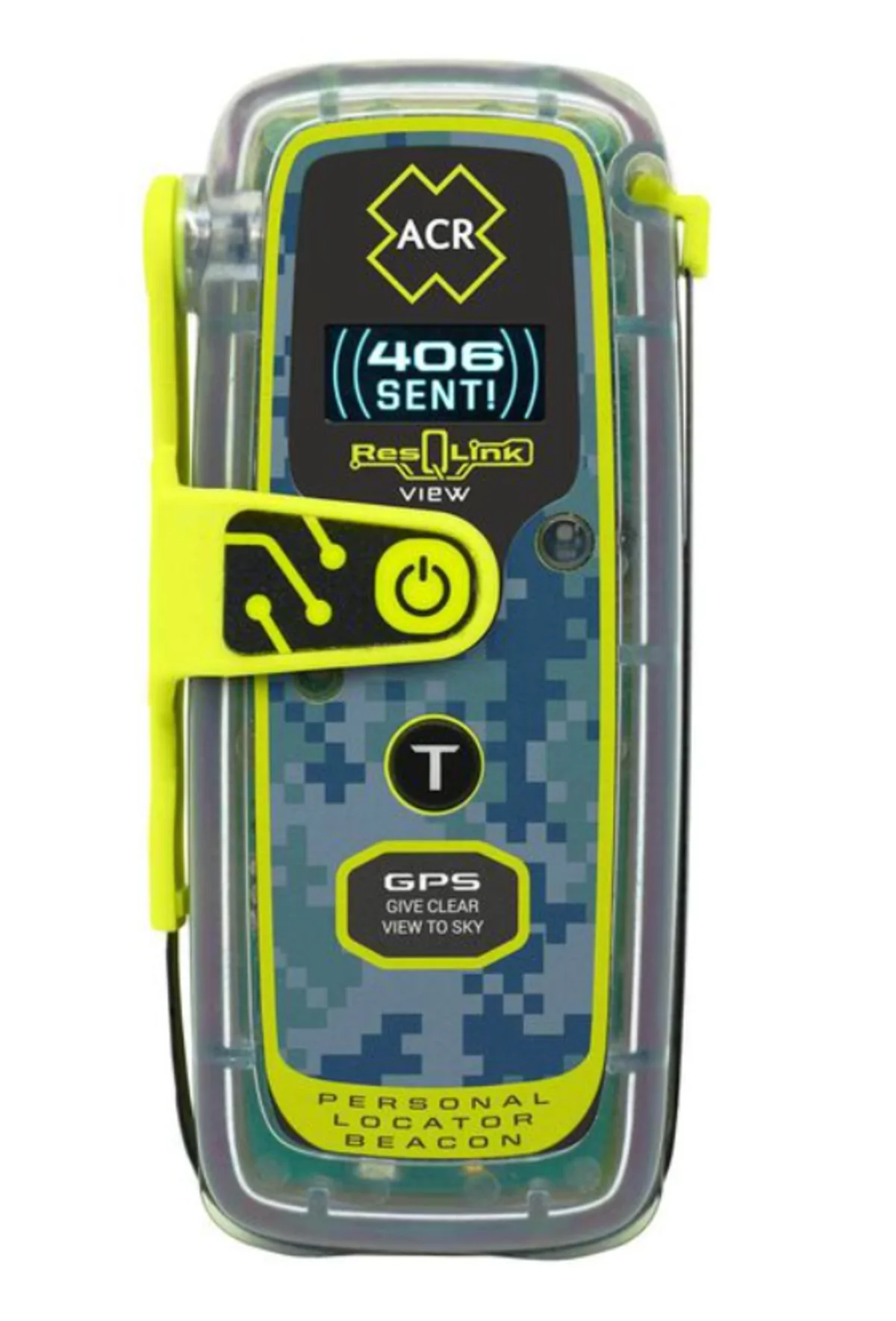
PLB, the lower-cost entry point: the ACR ResQLink 400 is GPS-enabled, small enough to clip to a PFD, and doesn’t require a boat-mounted bracket — a good pick for a boat that doesn’t want to commit to a full EPIRB install, or as a second, personal-carry unit for whoever’s most likely to end up in the water. The ResQLink View adds an LCD screen that confirms GPS lock and transmission status — genuinely useful reassurance in the moment you’re actually using it, for a modest premium.
EPIRB, for the boat itself: the ACR GlobalFix V6 is the current-generation standard, GPS-enabled, and sold in two versions — the Category I automatic, float-free version and the Category II manual version, running about $105 apart. If you fish short-handed with any regularity, spend the extra money on the Category I version — it’s the one that still works if nobody’s in a position to activate it.
Worth knowing about: AIS man-overboard beacons are a related, complementary category, not a replacement for either of the above. They broadcast to nearby AIS-equipped vessels within a few miles instantly, which is a faster local response than waiting on a satellite fix — genuinely useful for a crew-overboard situation where the boat itself isn’t in danger, distinct from a full abandon-ship emergency.
What actually goes in the ditch bag
The safety checklist covers this briefly; here’s the fuller version. Everything in this bag needs to survive being thrown into open water, so pack it in a dry bag or a purpose-built ditch bag, not a backpack:
- The PLB or EPIRB, if it isn’t already worn on a PFD
- A handheld VHF radio — see the VHF/DSC setup guide for why a GPS-linked handheld matters here specifically
- A signal mirror and a pealess whistle
- A few day/night visual distress flares, sealed in a waterproof pouch
- Glow sticks — flares run out fast; glow sticks last through a long night
- A space blanket per person
- Drinking water in sealed pouches, not a bottle that can rupture
- A basic first aid kit, sized for the bag rather than the boat
- Seasickness medication — a life raft rocks far worse than the boat did
- A knife or multitool
- A laminated card with the boat’s documentation, MMSI number, and an emergency contact
- Sunscreen or lip balm if the situation stretches into daylight hours
Use a bag in a bright color — orange or yellow, not black — stow it somewhere every person aboard knows to grab without being told, and check the batteries and flare expiration dates twice a year. A ditch bag that’s been sitting untouched since it was packed is a bag nobody’s actually checked works.
Bottom line
A PLB clipped to a PFD is the cheapest real insurance policy on the boat, and a Category I EPIRB is the version that works even if nobody’s in a position to activate it. Register whichever one you buy, budget for the battery replacement down the road, and build the ditch bag once — properly — instead of planning to get to it next trip.
This article may contain affiliate links. If you buy through them, we may earn a small commission at no extra cost to you. Learn more.